Key Takeaways
JEE Main Paper 1 (B.E./B.Tech) has 75 questions (25 each in Physics, Chemistry and Mathematics) for 300 marks, to be solved in 3 hours. Each correct answer earns +4 marks. MCQs carry -1 for a wrong answer, and numerical-value questions carry no negative marking. Paper 2A (B.Arch) and Paper 2B (B.Planning) carry 400 marks each.
Note: This pattern is based on the latest NTA Information Bulletin.
The preparations for JEE Main need to be made keeping the pattern of JEE Main examinations in mind. The knowledge about this can help the candidates organize themselves and make their preparations effective as well as make their decisions in the examination.
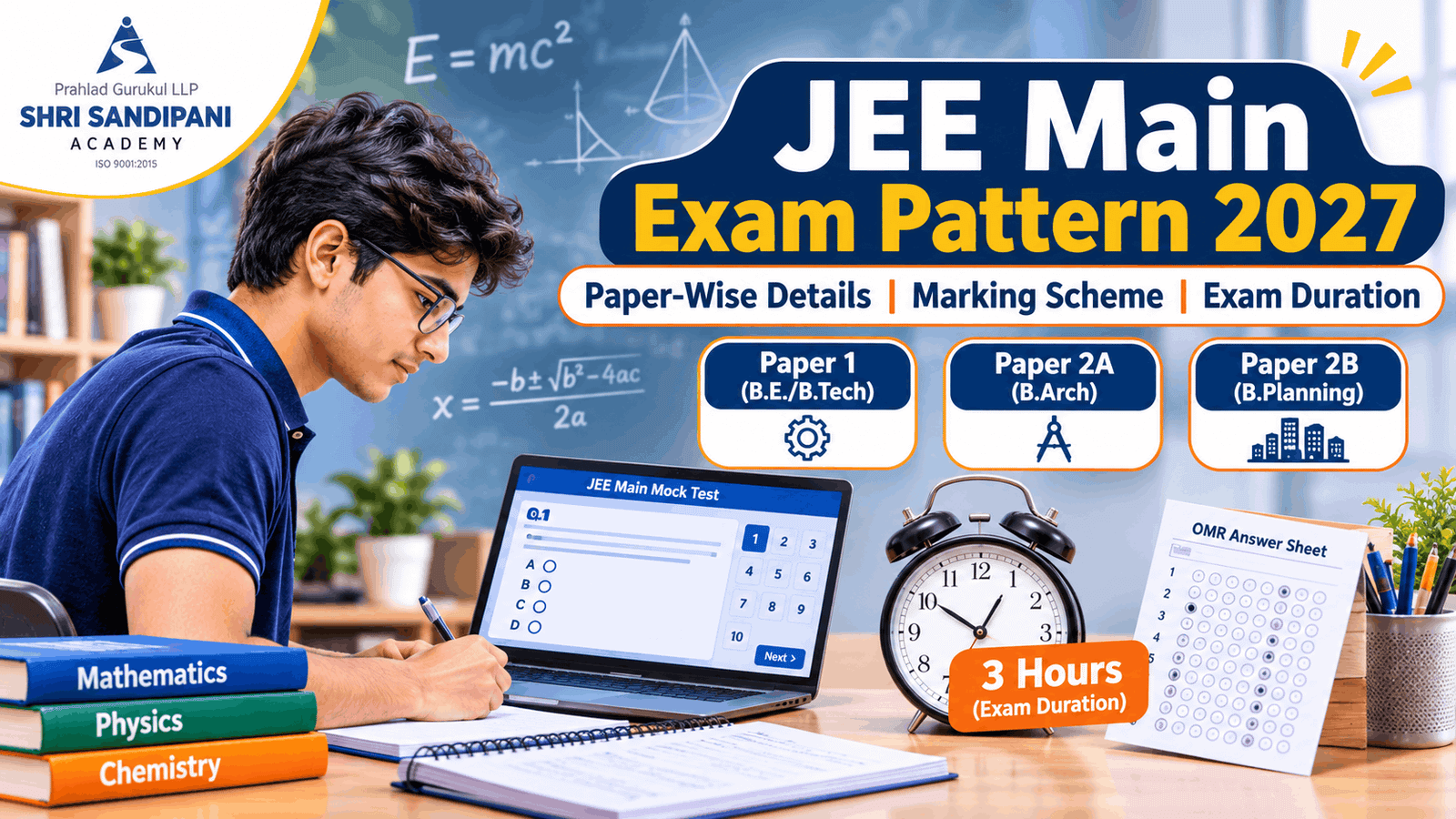
The JEE Main Exam Pattern 2027 gives information about the three papers taken for admission to engineering, architecture and planning courses. The candidates need to know the requirements of the particular paper before starting the preparations. Below is the detailed pattern of each paper.
Overview of the JEE Main Exam Pattern 2027
The Joint Entrance Examination Main is organized by NTA in a computer-based format for aspirants who are planning to join different engineering and allied disciplines. There are three papers in the test according to the program one wants to apply for.
• Paper 1 – BE/B.Tech
• Paper 2A – B.Arch
• Paper 2B – B.Planning
As per the exam pattern mentioned above, Paper 1 is of 300 marks, whereas Papers 2A and 2B have 400 marks each. The duration is usually three hours, though different provisions may be made for eligible candidates.
Having knowledge about the JEE exam pattern and syllabus simultaneously will enable the candidates to know what subjects they must study and what types of questions to expect.
Quick Comparison: Paper 1 vs Paper 2A vs Paper 2B
| Particulars | Paper 1 (B.E./B.Tech) | Paper 2A (B.Arch) | Paper 2B (B.Planning) |
| Subjects | Physics, Chemistry, Mathematics | Mathematics, Aptitude, Drawing | Mathematics, Aptitude, Planning |
| Total questions | 75 | 77 | 100 |
| Total marks | 300 | 400 | 400 |
| Mode | CBT | CBT (Drawing offline, on paper) | CBT |
| Duration | 3 hours | 3 hours | 3 hours |
What Changed from Earlier Years?
Many students still follow old coaching material and videos, so note these changes:
• Section B (numerical) in Paper 1 is now fully compulsory. The older “attempt any 5 out of 10” choice has been removed.
• Each subject now has 25 questions (20 MCQs + 5 numericals) instead of 30.
• Always check the latest NTA bulletin before relying on any older pattern.
Structure of JEE Main Exam Paper 1
JEE Main Exam Paper 1 is set for those who are aspiring to join B.E./B.Tech courses. The subjects covered in this exam paper include Physics, Chemistry, and Mathematics, and the total marks for each of the subjects is 100.
The JEE Main Exam Paper Pattern for Paper 1 includes the following structure:
| Particulars | Details |
| Examination mode | Computer-based test |
| Duration | 3 hours |
| Subjects | Physics, Chemistry and Mathematics |
| Total questions | 75 |
| Total marks | 300 |
| Questions per subject | 25 |
| Question types | Multiple-choice and numerical-value questions |
All subjects consist of 20 MCQs and five numerical value-based questions. As per the mentioned pattern, all questions are mandatory, including the numerical value-based questions.
Both kinds of questions should be practiced by students. MCQs need a thorough analysis of all options, while numerical questions involve precise calculation and concept knowledge. Knowing the total marks of jee mains and how they are divided across subjects will also help students set realistic score targets while preparing for each subject.
How Much Time Should You Spend on Each Subject?
The paper gives you 180 minutes for 75 questions, which is about 2.4 minutes per question. A practical split is roughly 55 to 60 minutes per subject. Do not leave Section B for the last 10 minutes of the paper. Numerical questions carry the same +4 marks as MCQs and have no negative marking, so give them proper time. [Add one or two observations from your own batches here, for example the order of attempt that worked best for your students.]
JEE Main Exam Pattern for Paper 2
Paper 2 is designed for candidates who want to pursue a career in the fields of architecture and planning. There are two different papers, namely Paper 2A for B.Arch and Paper 2B for B.Planning. These papers carry 400 marks each and usually last for three hours.
JEE Main Exam Pattern for Paper 2 is quite different from Paper 1 as it has aptitude and planning-related questions.
| Particulars | Paper 2A (B.Arch) | Paper 2B (B.Planning) |
| Subjects | Mathematics, Aptitude, Drawing | Mathematics, Aptitude, Planning |
| Total questions | 77 | 100 |
| Total marks | 400 | 400 |
| Examination mode | CBT, with drawing conducted offline | CBT |
| Duration | 3 hours | 3 hours |
Paper 2A consists of 25 Mathematics problems, 50 Aptitude problems, and two drawing assignments. Paper 2B consists of 25 Mathematics problems, 50 Aptitude problems and 25 Planning problems.
Marks Distribution for Paper 2A and Paper 2B
| Section | Paper 2A (B.Arch) | Paper 2B (B.Planning) |
| Mathematics | 25 questions, 100 marks | 25 questions, 100 marks |
| Aptitude | 50 questions, 200 marks | 50 questions, 200 marks |
| Drawing | 2 questions, 100 marks | – |
| Planning | – | 25 questions, 100 marks |
| Total | 77 questions, 400 marks | 100 questions, 400 marks |
How Is the Drawing Test Conducted in Paper 2A?
The drawing test is taken offline, on an A4 size drawing sheet, using pen or pencil, while the rest of the paper is computer-based. It tests your sense of proportion, composition, perspective, texture, shading and the ability to sketch objects, scenes and memory-based drawings. Practise drawing within the time limit, because neat and complete work scores better than an ambitious but unfinished sketch.
The student must choose the right paper depending on his/her desired course and be prepared for the corresponding demands. The candidate must also refer to the official information bulletin for up-to-date information about the exam.
JEE Main 2027 Exam Total Questions (Paper-Wise)
In the JEE Main examination, there are 3 papers which students have the choice of taking. Therefore, the total number of questions is also different. To know the number of questions in each section of the JEE Main examination, below is the complete overview.
Total Number of Questions in JEE Main Paper 1 (B.E./B.Tech)
| Subject | Section A | Section B | Type of Questions |
| Mathematics | 20 Q | 5 Q | MCQs in Section A, Numericals in Section B |
| Physics | 20 Q | 5 Q | MCQs in Section A, Numericals in Section B |
| Chemistry | 20 Q | 5 Q | MCQs in Section A, Numericals in Section B |
| Total number of Questions | 60 Q | 15 Q | 75 Questions in Total |
Total Number of Questions in JEE Main Paper 2A (B.Arch)
| Subject | Section A | Section B | Type of Questions |
| Mathematics – Part 1 | 20 Q | 5 Q | MCQs in Section A, Numericals in Section B |
| Aptitude – Part 2 | 50 Q | – | Aptitude level questions |
| Drawing – Part 3 | – | – | 2 questions in the complete drawing section |
| Total number of Questions | – | – | 77 Questions in Total |
Total Number of Questions in JEE Main Paper 2B (B.Plan)
| Subject | Section A | Section B | Type of Questions |
| Mathematics – Part 1 | 20 Q | 5 Q | MCQs in Section A, Numericals in Section B |
| Aptitude – Part 2 | 50 Q | – | Aptitude level questions |
| Planning – Part 3 | 25 Q | – | Planning-based questions |
| Total number of Questions | – | – | 100 Q in total |
Understanding the JEE Main Marking Scheme
Knowing how marks are awarded is essential for developing an effective attempt strategy. The JEE Main Marking Scheme follows a reward-and-penalty system for objective and numerical-value questions.
The marking scheme is summarized below:
• Correct answer: +4 marks
• Incorrect answer: −1 mark (for MCQs)
• Incorrect numerical-value answer: 0 marks (no negative marking)
• Unattempted question: 0 marks
In paper 1, each topic accounts for 100 marks, and thus the maximum marks are 300. Papers 2A and 2B have 400 marks each. In Paper 2A, the drawing exercises will be marked independently, and each drawing question carries 50 marks. Students must follow the instructions given on the drawing sheet.
The negative marking system implies that an attempt at guessing the answers in MCQs will lower your mark if your guesses are wrong too often. Therefore, you need to concentrate on getting your answers correct and also on timing yourself while answering questions.
Worked Example: How to Calculate Your Score
Suppose that in Physics you answer 18 MCQs correctly, 2 MCQs incorrectly, 4 numerical questions correctly, 1 numerical incorrectly and leave nothing else.
• Correct answers: 18 + 4 = 22 × 4 = +88
• Incorrect MCQs: 2 × (−1) = −2
• Incorrect numerical: 0
• Physics score = 86 out of 100
Should You Guess in MCQs?
With +4 for correct and -1 for wrong, a blind guess among 4 options has a small positive expected value (0.25 × 4 − 0.75 × 1 = +0.25). But this works only over many questions and is risky if your concepts are weak. A smarter approach is to eliminate at least two options first and then decide. Always attempt every numerical question, since there is no penalty.
Here is the detailed breakdown of the JEE Main Marking Scheme
| Particulars | Paper 1 (B.E./B.Tech) | Paper 2A (B.Arch) | Paper 2B (B.Plan) |
| Conducting Body | NTA (National Testing Agency) | NTA (National Testing Agency) | NTA (National Testing Agency) |
| Total Time Duration | 3 hours (4 hours for PwD candidates) | 3 hours (180 mins) (compensatory time for PwD candidates as per NTA rules) | 3 hours (180 mins) (compensatory time for PwD candidates as per NTA rules) |
| Mode of Exam | Computer-Based Test (CBT) | Computer-Based Test (CBT) (Drawing offline) | Computer-Based Test (CBT) |
| Total Marks | 300 Marks (100 marks in each section) | 400 Marks | 400 Marks |
| Subjects | Physics, Mathematics, and Chemistry | Mathematics, Drawing section, and Aptitude | Mathematics, Aptitude-based section, and Planning-Based section |
| Total Number of Questions | 75 Questions | 77 Questions | 100 Questions |
| Number of Questions (Section-Wise) | Physics – 25Q, Mathematics – 25Q, Chemistry – 25Q | Mathematics – 25Q, Drawing section – 2Q, Aptitude Section – 50Q | Mathematics – 25Q, Aptitude Section – 50Q, Planning Section – 25Q |
| Type of Questions | 20 MCQs and 5 Numerical Value Questions (same for each section) | MCQs in Maths and Aptitude section; Drawing-type questions | MCQs, Numerical Value Questions, Planning-Based Questions |
| Marking Scheme | +4 for every correct attempt; −1 for every incorrect MCQ attempt; 0 for incorrect numerical and unattempted questions | +4 for every correct attempt, −1 for every incorrect MCQ attempt; 0 marks for unattempted question | +4 for every correct attempt and −1 for every incorrect MCQ attempt; 0 marks for unattempted question |
Exam Sessions, Languages and Exam-Day Rules
1. Sessions and attempts: JEE Main is conducted in two sessions in a year (January and April). You can appear in one or both, and the better of your valid scores is considered for the rank list.
2. Languages: Paper 1 is available in English, Hindi, Gujarati and many other regional languages, including Marathi.
3. Calculators: Not allowed. Rough sheets are provided at the centre and have to be returned.
4. Percentile: NTA publishes percentile scores, not just raw marks, using normalization across shifts. The same raw score can give different percentiles in different shifts, so do not compare scores shift to shift.
Common Mistakes Students Make
• Leaving Section B for the last few minutes
• Preparing from an old pattern (for example, expecting the “attempt 5 of 10” choice)
• Blind guessing in MCQs without eliminating options
• Ignoring the Paper 2 drawing and aptitude practice until the last month
Exam Preparation in Accordance with the Pattern of the Exam
When students are clear about the pattern of the exam paper, they can prepare themselves in accordance with the exam requirements. First of all, they need to divide the syllabus into various topics and set up learning goals on a weekly basis.
Preparation for JEE Main requires students to revise concepts, solve numerical problems, take mock tests, and analyze their mistakes. Previous years’ questions will be useful for gaining familiarity with the typical pattern of the questions. For a week-by-week schedule, follow our JEE Mains Preparation plan.
It is possible for students to make their own JEE Main preparation timetable, which will incorporate studies in school, coaching classes, personal revisions, and mock tests. The mistakes made in each test should be analyzed to pinpoint any weakness in understanding certain concepts or making calculations.
Those students who wish to qualify for IITs must have knowledge about the format of JEE Advanced too, but their preparation must be done simultaneously along with the preparation of the JEE Main syllabus. Read the jee advanced exam pattern to see how it differs from JEE Main in paper structure and marking.
FAQs
1. How many questions are there in JEE Main Paper 1?
Paper 1 has 75 questions: 25 each in Physics, Chemistry and Mathematics (20 MCQs and 5 numericals per subject).
2. What are the total marks in JEE Main?
Paper 1 is 300 marks. Papers 2A and 2B are 400 marks each.
3. Is there negative marking in JEE Main?
Yes, -1 for each incorrect MCQ. Numerical-value questions have no negative marking.
4. Are all questions compulsory in JEE Main Paper 1?
Yes. All 75 questions, including the numericals, are compulsory under the current pattern.
5. What is the duration of JEE Main?
3 hours for every paper, with compensatory time for eligible PwD candidates.
6. What is the marks distribution in Paper 2A (B.Arch)?
Mathematics 100, Aptitude 200 and Drawing 100.
7. Is a calculator allowed in JEE Main?
No. Rough sheets are provided at the exam centre.
8. How should I start preparing for JEE Main as per the pattern?
Divide the syllabus weekly, solve previous year’s papers and take regular mocks.
Conclusion
Knowing about the JEE Main Exam Pattern 2027 will definitely help candidates to plan their preparations in a better manner. Whether it is 75 questions of Paper 1 or unique requirements of Paper 2A and 2B, students need to make proper plans for all three papers.
Candidates must stay updated regarding the official examinations and also practice questions in a regular manner. Check the official NTA website and the Information Bulletin regularly for any change in the 2027 pattern.
Seeking help with coaching for JEE Main in Ahilyanagar? Contact Shri Sandipani Academy to guide you. Students from Ahilyanagar and nearby areas can join our JEE Main batch to strengthen concepts and practise exam-based questions.

Dr. Balraju Karri is the founder of Shri Sandipani Academy, specializing in IIT-JEE, NEET, and MHT-CET preparation. With a strong academic background and multiple awards, he is known for delivering result-driven coaching and shaping student success.