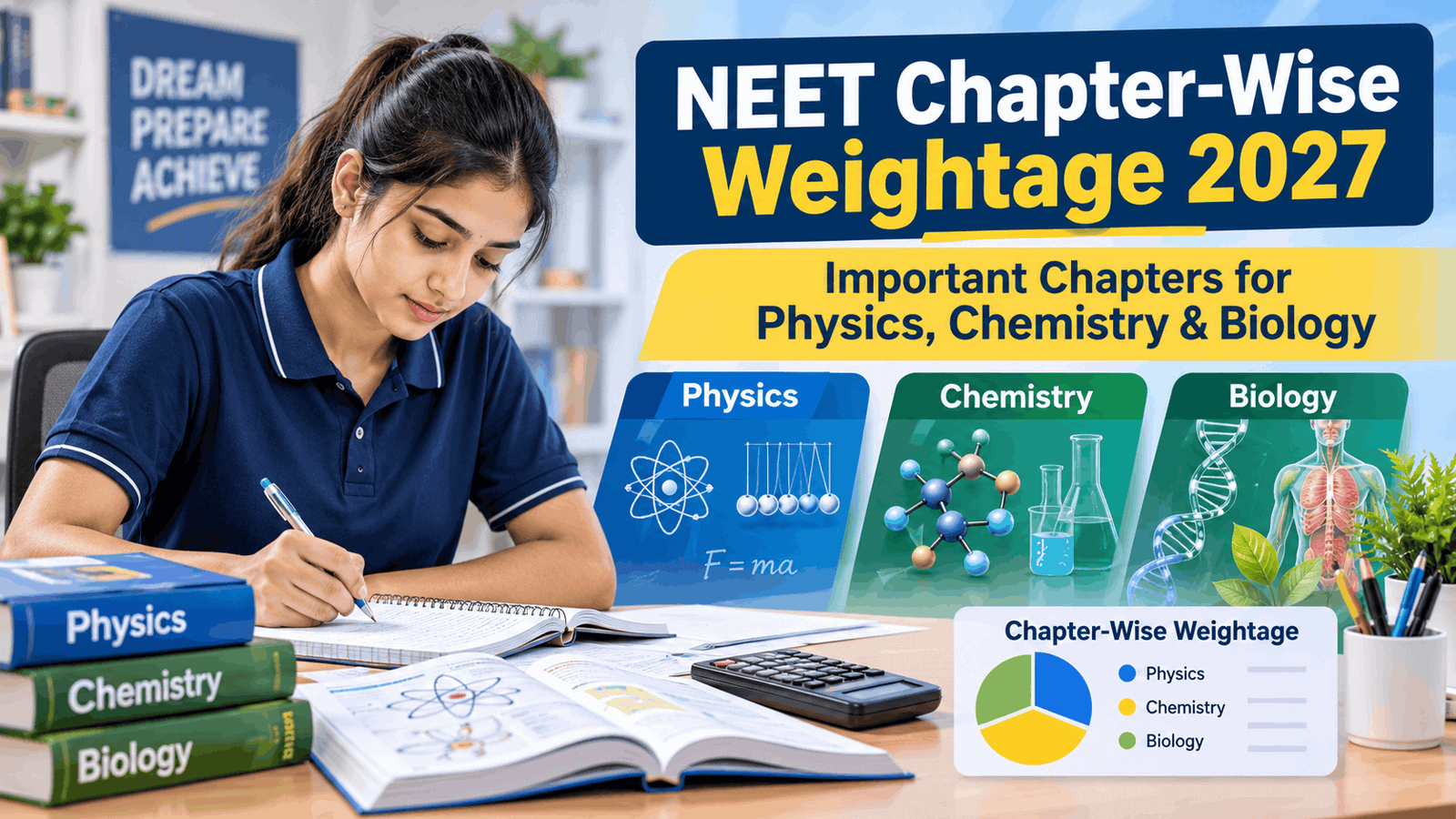
For preparing for NEET, it is essential for candidates to have clear knowledge about the syllabus, examination pattern, and the chapter-wise weightage. As the syllabus for NEET is very wide, including physics, chemistry, and biology, the students will have to prioritize some subjects while keeping up with a balanced routine of studies.
But still, the chapter-wise weightage of NEET 2027 is dependent upon the past exam trend and is subject to change each year.
NEET Subject-wise Marks Knowledge
The NEET UG test involves a total of 720 marks, which are allocated among three subjects: Physics, Chemistry, and Biology. Each of the first two subjects comprises 180 marks, whereas Biology includes 360 marks.
Being aware of the NEET subject-wise marks helps students plan their study timings on the basis of the importance and toughness of the subjects. Biology gives maximum marks in total, but students need to study all three subjects diligently.
It is important to know NEET Total marks too.
Weightage of Physics Chapters for NEET Exam
There is a need for clear concepts, numerical and formula-based learning in Physics. Topics like Current Electricity, Electrostatics, Laws of Motion, Work, Energy and Power, Modern Physics, Optics and Semiconductor Electronics deserve special mention while going through the old question papers.
The NEET Physics Chapter Wise Weightage will definitely help the students to know about the repeated topics and plan accordingly. But the number of questions from different chapters can differ in each exam.
For effective preparation, revisit the basics, solve numerical problems frequently, and attempt the previous year’s question papers within time constraints. NEET UG syllabus will help you make sure that your preparation is comprehensive.
| Chapters / Topics | Expected Questions | Weightage |
|---|---|---|
| Centre of Mass | 1 | 1% |
| Gravitation | 2 | 3% |
| Kinematics | 1 | 2% |
| Laws of Motion | 3 | 7% |
| Mechanical Properties of Solids and Fluids | 2 | 3% |
| Oscillations | 1 | 3% |
| Rotational Motion | 1 | 1% |
| Motion of System of Particles and Rigid Body | 3 | 7% |
| Units and Measurement | 1 | 2% |
| Waves | 2 | 4% |
| Work, Energy and Power | 2 | 4% |
| Kinetic Theory | 1 | 2% |
| Properties of Bulk Matter | 1 | 3% |
| Thermal Properties of Matter | 1 | 2% |
| Thermodynamics | 3 | 7% |
| Magnetic Effects of Current and Magnetism | 3 | 6% |
| Electric Charges and Fields | 1 | 2% |
| Electromagnetic Waves | 1 | 1% |
| Electrostatic Potential and Capacitance | 1 | 2% |
| Electrostatics | 1 | 3% |
| Alternating Currents | 1 | 3% |
| Current Electricity | 3 | 6% |
| Electromagnetic Induction | 1 | 2% |
| Semiconductor Electronics | 3 | 6% |
| Atoms and Nuclei | 2 | 5% |
| Dual Nature of Radiation and Matter | 2 | 4% |
| Ray Optics and Optical Instruments | 3 | 5% |
| Wave Optics | 2 | 4% |
NEET Chemistry Chapter Wise Weightage
Chemistry consists of theoretical part, numerical problems, and chemical reactions-based questions. Some important topics of Chemistry include Chemical Bonding, Coordination Compounds, Chemical and Ionic Equilibrium, Electrochemistry, Chemical Kinetics, Organic Chemistry, and certain chapters from the p-block and d-f block of elements.
By studying the Weightage of NEET Chemistry Chapter Wise, the aspirants will be able to get an idea regarding the topics that need further practice. Solving the numerical in Physical Chemistry, getting familiar with reaction mechanisms in Organic Chemistry, and studying Inorganic Chemistry systematically is essential.
Aspirants who want to follow a systematic way of study can refer to how to study NEET Chemistry.
| Chapters / Topics | Expected Questions | Weightage |
|---|---|---|
| Inorganic Chemistry – I | 2 | 22% |
| Chemical Bonding | 4 | 8% |
| p-Block | 3 | 6% |
| Periodic Table and Periodicity in Properties | 2 | 4% |
| Hydrogen | 1 | 2% |
| s-Block | 1 | 2% |
| Inorganic Chemistry – II | 1 | 2% |
| Coordination Compounds | 2 | 5% |
| d-Block and f-Block Elements | 2 | 3% |
| Metallurgy | 1 | 2% |
| Qualitative Analysis | 1 | 2% |
| Organic Chemistry – I | 7 | — |
| General Organic Chemistry and Practical Organic Chemistry | 2 | 4% |
| Hydrocarbons | 2 | 3% |
| Organic Chemistry – II | 27 | — |
| Aromatic Compounds | 3 | 6% |
| Haloalkane, Alkyl Halide, Alcohol and Ether | 2 | 3% |
| Biomolecules and Polymer | 2 | 3% |
| Carbonyl Compounds | 2 | 3% |
| IUPAC and Isomerism | 2 | 3% |
| Aldehydes, Ketones and Carboxylic Acids | 2 | 3% |
| Organic Compounds Containing Nitrogen | 2 | 3% |
| Chemistry in Everyday Life and Environmental Chemistry | 2 | 3% |
| Physical Chemistry – I | 17 | — |
| Mole Concept | 2 | 5% |
| Ionic Equilibrium | 2 | 4% |
| Atomic Structure and Nuclear Chemistry | 1 | 2% |
| Chemical Equilibrium and Gaseous State | 1 | 2% |
| Thermodynamics and Thermochemistry | 1 | 2% |
| Redox Reactions | 1 | 2% |
| Physical Chemistry – II | 15 | — |
| Chemical Kinetics | 2 | 4% |
| Solution and Colligative Properties | 2 | 4% |
| Electrochemistry | 1 | 3% |
| Solid State | 1 | 2% |
| Surface Chemistry | 1 | 2% |
Biology Section-wise Marks Distribution in NEET Exam
The subject of biology carries a total of 360 marks in the NEET exam. Human Physiology, Genetics and Evolution, Ecology, Reproduction, Cell Biology, Biotechnology and Plant Physiology are some of the crucial subjects for revision based on past trends in the NEET exam.
The NEET Biology Chapter Wise Weightage will assist candidates in focusing their studies on topics which have a high chance of being asked during the examination. Careful study of NCERT books, learning terms, and answering multiple-choice questions is vital for achieving greater precision.
It is imperative to revise diagrams, biological processes, and examples regularly. Do not rely entirely on chapter weightage but cover each topic from the syllabus prescribed.
Botany
| Chapters / Topics | Expected Questions | Weightage |
| Genetics and Evolution | 15 | 25% |
| Ecology and Environment | 10 | 16% |
| Plant Physiology | 8 | 14% |
| Plant Diversity | 7 | 12% |
| Cell Structure and Function | 6 | 10% |
| Plant Reproduction | 5 | 9% |
| Morphology of Flowering Plants | 4 | 7% |
| Plant Anatomy | 2 | 4% |
| Biomolecules | 2 | 3% |
| Total | — | 100% |
Zoology
| Chapters / Topics | Expected Questions | Weightage |
| Human Physiology | 13 | 45% |
| Human Reproduction and Reproductive Health | 5 | 16% |
| Animal Kingdom | 3 | 10% |
| Origin and Evolution | 3 | 10% |
| Human Health and Diseases | 3 | 9% |
| Structural Organisation in Animals | 2 | 5% |
| Animal Husbandry | 1 | 3% |
| Biology and Human Welfare | 1 | 2% |
| Total | — | 100% |
High Weightage Chapters in NEET 2026: Lessons for Aspirants
By studying the high weightage chapters in NEET 2026, students can analyze the patterns of past examinations and learn about the kind of questions that have been asked before. They can also prepare for NEET 2027 on the basis of these observations.
But that does not mean that the trends of the past will be repeated in the coming papers. Aspirants must take the weightage of chapters only as a guide but not as an excuse for avoiding them altogether. A combination of revising concepts, taking mock tests, and analyzing one’s performance could definitely help.
NEET Preparation Planning Guide
The planning process for NEET must involve a schedule of regular studies, revision of topics, and solving questions and mock tests. It is necessary to divide the syllabus into small portions and study it weekly and check the status of your performance in each subject.
It is important to draw a proper NEET 2027 preparation timetable in which all three subjects are included. It is essential to revise mistakes from every test and revisit those topics where you make mistakes regularly.
Get ready for NEET 2027 at Shri Sandipani Academy
Knowing the weightage of chapters in NEET preparation is important, but NEET preparation requires more than just that. Conceptual clarity, regular practice, and proper guidance will ensure your success in this examination. This is where Shri Sandipani Academy can help you out.
Searching for Ahilyanagar’s leading NEET coaching classes? Reach out to Shri Sandipani Academy for information on NEET preparation and take a step closer to realizing your dreams of medical entrance exams.

Dr. Balraju Karri is the founder of Shri Sandipani Academy, specializing in IIT-JEE, NEET, and MHT-CET preparation. With a strong academic background and multiple awards, he is known for delivering result-driven coaching and shaping student success.
[…] Also read – NEET Chapter Wise Weightage 2027 […]